Colored contact lenses can be a fun way to change your look, whether you want a subtle boost to your natural eye color, a bold new shade for a special event or a costume look for a party. They are easy to find in beauty shops, gas stations, flea markets and pop-up websites, and many are sold as if they were makeup. They are not makeup. In the United States, every contact lens, including purely decorative lenses with no vision correction, is a medical device that requires a valid prescription. If you live in Port St. Lucie, Tradition, St. Lucie West, Torino, Sandpiper Bay or Tesoro and are thinking about colored contacts, here is what you should know first.
Colored Contacts Are Medical Devices, Not Cosmetics
The U.S. Food and Drug Administration (FDA) regulates decorative contact lenses the same way it regulates corrective lenses. According to the FDA, decorative lenses are not cosmetics or over-the-counter merchandise, and places that sell them as cosmetics or without a prescription are breaking the law. That rule applies whether the lens changes your eye color, adds a pattern, or also corrects nearsightedness or farsightedness.
The reason is simple: anything that sits directly on the surface of your eye can affect its health. A lens has to be the right size and shape for your eye, made from a material that lets enough oxygen reach the cornea, and cleaned and replaced on the right schedule.
Why “One Size Fits All” Doesn’t Work for Eyes
Eyes vary in size and curvature. A contact lens that is too tight can limit oxygen and tear flow to the cornea. A lens that is too loose can move around, rub the eye and blur your vision. During a contact lens fitting, your eye doctor measures each eye and checks how the lens sits and moves, then looks at how your eyes respond to wear.
The FDA and the American Academy of Ophthalmology both warn that poorly fitting or unregulated decorative lenses can lead to problems such as:
- Scratches on the cornea (corneal abrasions)
- Painful eye infections, including corneal ulcers
- Pink eye and irritation
- Decreased vision, and in serious cases, vision loss
Some lenses sold without a prescription may also use colorants or materials that have not been reviewed for safety, which adds another layer of risk.
What Happens at a Colored Contact Lens Fitting
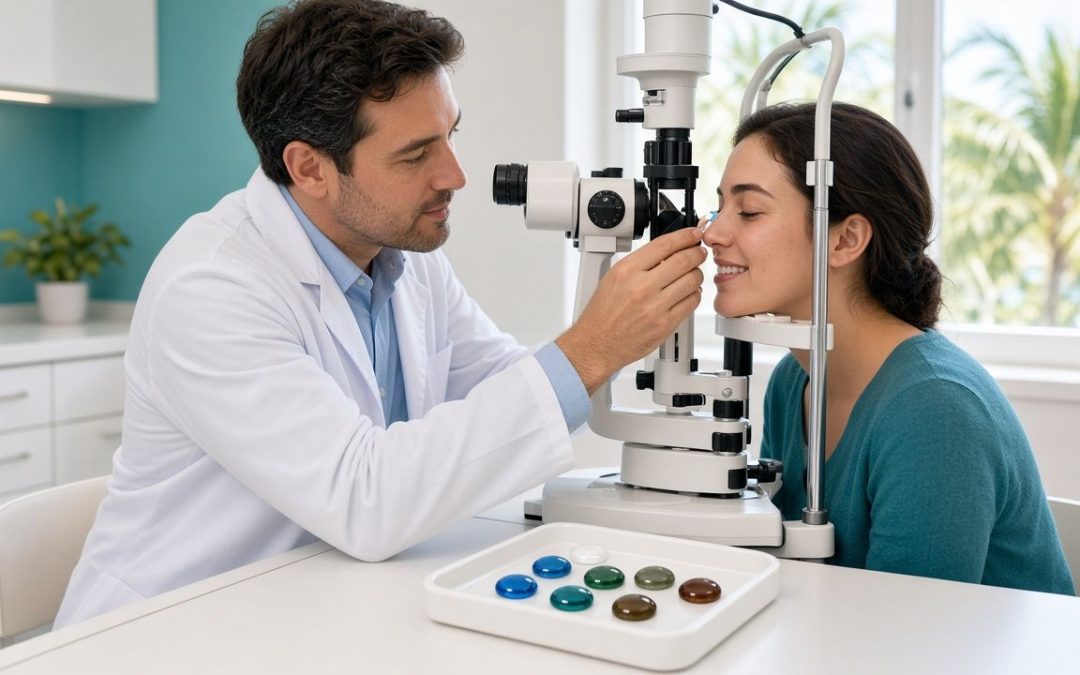
Getting colored contacts the safe way is straightforward. At St. Lucie Family Eye Care, a visit usually includes:
- An eye exam. We check your vision and the overall health of your eyes. If you need vision correction, many colored lenses can include your prescription. Learn more about our comprehensive eye care.
- Measurements and fit. We measure your eyes and evaluate how a lens fits on the surface so it stays comfortable and healthy.
- Lens and color options. We talk about enhancement tints, which deepen your natural color, and opaque tints, which can change the color more dramatically, along with replacement schedules that fit your routine.
- Insertion, removal and care training. New wearers learn how to handle lenses and keep them clean.
- A written prescription. Your prescription lists the exact lens brand, size and power that fit your eyes.
You can read more about the lens types we fit on our contact lenses page.
Smart Habits for Wearing Colored Contacts
Once you have the right lenses, safe habits matter just as much as the fit:
- Never share lenses. Swapping lenses with a friend can spread bacteria and infection.
- Wash and dry your hands before touching your lenses or eyes.
- Use fresh solution every time. Never use water or saliva to rinse or store lenses.
- Follow the replacement schedule. Throw away daily lenses after one use and replace other lenses when directed.
- Don’t sleep in them unless your eye doctor has specifically approved it for your lenses.
- Keep lenses away from water, including pools, hot tubs, showers and the ocean.
- Put lenses in before makeup and take them out before removing it.
Know the Warning Signs
If you notice eye redness, pain, discharge, light sensitivity or blurry vision while wearing any contact lenses, take the lenses out and contact an eye doctor promptly. These can be signs of an infection or injury that needs attention. Our urgent eye care page explains how we can help. For a true emergency, such as a chemical splash, a serious injury to the eye or sudden vision loss, go to the nearest emergency room or call 911.
Colored Contacts for Teens
Teens are often the first to want colored contacts, especially around holidays, dances and costume events. Contacts can be a good option for many responsible teens, but they still need a fitting and a prescription, and a parent should help make sure care routines are followed. If your teen is curious, bring them in so we can check their eyes and talk through what is involved.
Frequently Asked Questions
Do I need a prescription for colored contacts if I have perfect vision?
Yes. Even “plano” lenses with no vision correction are medical devices under FDA rules, so you still need an eye exam and a fitting to get a valid prescription.
Is it safe to buy colored contacts from a beauty supply store or costume shop?
The FDA says it is illegal to sell decorative contact lenses without a prescription. Buy only from your eye doctor or a seller that asks for and verifies your prescription.
Can colored contacts correct my vision too?
Many colored lenses are available with vision correction. Your eye doctor can tell you which options are available for your prescription.
Can I wear colored contacts if I have astigmatism?
Options for astigmatism are more limited, but some colored lenses may work. A fitting is the best way to find out what suits your eyes.
Get Fitted for Colored Contacts in Port St. Lucie
A new eye color should never come at the cost of healthy eyes. St. Lucie Family Eye Care, at 702 SW Port St Lucie Blvd, Port St. Lucie, FL 34953, can examine your eyes, fit you for lenses and help you choose a look you love. Call (772) 873-0037 or request an appointment online.